Finepack journal
TTO Printer for Packaging: How to Select the Right Model for Your Line
A thermal transfer overprinter (TTO) is the right coding technology for flexible film packaging when you need sharp, durable variable data — batch codes, MFD/EXD dates, MRP, barcodes — printed inline at speeds up to 150…
28 September 2026
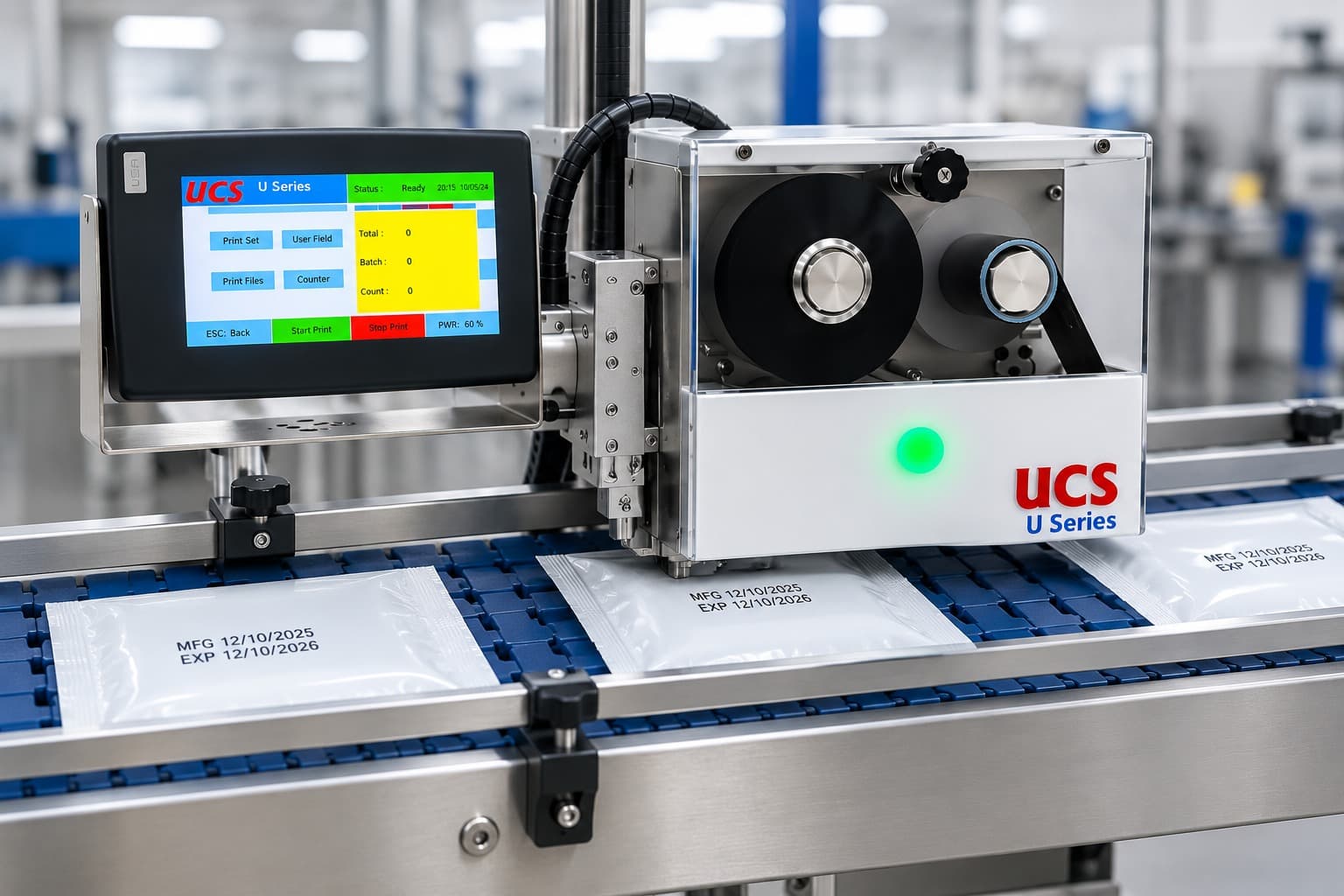
A thermal transfer overprinter (TTO) is the right coding technology for flexible film packaging when you need sharp, durable variable data — batch codes, MFD/EXD dates, MRP, barcodes — printed inline at speeds up to 150 metres per minute. If you are running BOPP, polyethylene, laminated film, or foil pouches and your current inkjet or hot-stamp system is producing smeared codes or failing barcode verification, a TTO printer is the likely fix. This guide covers how to match TTO specifications to your line before you purchase — not after.
What a TTO Printer Actually Does (and Where It Fits)
A TTO printer transfers ink from a wax or wax-resin ribbon onto a moving film substrate using a heated print head. The print head presses the ribbon against the film for a controlled dwell time, transferring a precise image. Unlike continuous inkjet (CIJ), there is no solvent, no nozzle clogging, and no ink replenishment during production.
TTO is designed specifically for flexible packaging film. It is not suitable for rigid substrates, corrugated cartons, or glass. Its natural home is:
- Vertical form-fill-seal (VFFS) machines
- Horizontal flow wrappers
- Pouch filling lines
- Sachet machines
- Overwrapping lines
If your packaging line uses any of these formats and you need to print variable data that must pass GS1 barcode verification or FSSAI/BIS date-marking compliance, TTO is the technology to evaluate seriously.
Four Specifications That Determine Whether a TTO Printer Fits Your Line
Do not evaluate TTO printers on brand name alone. These four parameters determine compatibility with your specific line.
1. Print Head Width
TTO print heads typically range from 32 mm to 107 mm wide. Your print area requirement depends on label size, number of lines of text, and barcode dimensions. Oversizing the head wastes ribbon. Undersizing forces you to compromise on code layout or barcode grade.
Measure your required print area precisely before shortlisting models.
2. Print Speed
TTO print speed is rated in metres per minute (m/min) or packs per minute (ppm), depending on the manufacturer. Typical ranges:
- Entry-level: 40–80 m/min
- Mid-range: 80–150 m/min
- High-speed: up to 200 m/min on some models
Match the TTO's rated speed to your VFFS or flow wrapper's maximum film draw speed — not your current operating speed. Lines get upgraded. The printer should not become the bottleneck.
3. Ribbon Type and Width
TTO ribbons are either wax, wax-resin, or full resin. The choice depends on your substrate:
| Ribbon Type | Substrate Compatibility | Durability | Cost |
|---|---|---|---|
| Wax | Uncoated or matte films | Low–Medium | Lowest |
| Wax-Resin | BOPP, PE, coated films | Medium–High | Mid |
| Full Resin | Foil, high-gloss films, harsh environments | Highest | Highest |
For most food and FMCG flexible packaging in India — BOPP pouches, multilayer laminates — wax-resin is the standard choice. Pharma blister foil and chemical pouches typically require full resin.
Ribbon width must match the print head width. Mismatched ribbon wastes material and can damage the head.
4. Integration Protocol
Your TTO printer must communicate with the host packaging machine. Most modern TTO units support:
- RS-232 / RS-485 serial interfaces (older VFFS machines)
- Ethernet / TCP-IP (newer lines with SCADA or ERP integration)
- Digital I/O for trigger signals and encoder feedback
Confirm the interface protocol with both your TTO supplier and your packaging machine OEM before finalising the order. Retrofit integration failures are one of the most common — and avoidable — commissioning delays.
Substrate Compatibility: The Check Most Buyers Skip
TTO print quality is highly sensitive to film surface energy, texture, and temperature tolerance. A ribbon and head combination that performs perfectly on one film may produce faded or smeared codes on a different substrate from the same supplier.
Before finalising a TTO printer, request a substrate trial using your actual production film. Send samples of every film SKU you run — different suppliers, different grades — to the TTO vendor for test prints. Evaluate:
- Adhesion (scratch test after 24 hours)
- Edge sharpness at your target speed
- Barcode grade (minimum Grade C under ISO/IEC 15416 for most retail requirements; Grade A or B for pharma)
Do not accept a demo on a generic film as proof of compatibility with your specific substrate.
Common Mistakes When Buying a TTO Printer in India
These mistakes appear repeatedly in plant audits and post-installation complaints:
- Buying on print head price alone. Ribbon cost over 12 months often exceeds the printer's purchase price. Calculate total cost of ownership, not just capital cost.
- Ignoring encoder resolution. If your packaging machine does not have a high-resolution encoder, print quality degrades at speed. Confirm encoder specification before installation.
- Underspecifying the print head width. A 32 mm head cannot print a 2D Data Matrix barcode plus three lines of variable text. Map your code layout first.
- No spare head on-site. Print heads are consumable items. A failed head without a spare stops the line. Budget for at least one spare head per printer.
- Skipping operator training. TTO ribbon loading, tension adjustment, and head cleaning require trained operators. Untrained operators damage heads and produce non-compliant codes.
TTO vs. CIJ vs. Hot Stamp: When to Choose TTO
This is not a comprehensive technology comparison — a separate CIJ buyer's guide covers inkjet in depth. For flexible film applications specifically, here is the decision logic:
| Criterion | TTO | CIJ | Hot Stamp |
|---|---|---|---|
| Substrate | Flexible film only | Most substrates | Flexible film, foil |
| Variable data | Full variable (barcodes, text, logos) | Full variable | Limited (date/batch wheels) |
| Print resolution | Typically 300 dpi | 150–300 dpi | Low (embossed only) |
| Solvent/ink cost | Ribbon only | Ink + solvent | Foil only |
| Changeover time | Fast (digital) | Fast | Slow (manual wheel change) |
| Maintenance | Head cleaning, ribbon path | Nozzle flushing, ink system | Minimal |
Choose TTO when: you need barcode-grade print quality on flexible film, you require frequent variable data changes, and you want to eliminate solvent-based inks from the line.
Checklist: Before You Place a TTO Printer Order
Use this before signing a purchase order:
- Print area dimensions confirmed (width × height in mm)
- Maximum film speed of packaging machine documented (m/min)
- Substrate samples sent for ribbon compatibility trial
- Barcode grade requirement confirmed (ISO grade, GS1 standard)
- Interface protocol verified with packaging machine OEM
- Encoder type and resolution confirmed
- Ribbon type selected (wax / wax-resin / full resin) per substrate
- Spare print head included in the order
- Operator training scheduled as part of commissioning
- After-sales service coverage and spare parts lead time confirmed
How Ace Finepack Supports TTO Selection and Integration
Ace Finepack Private Limited supplies TTO printers for flexible packaging lines across food, pharma, FMCG, and chemical manufacturing in India. The selection process includes substrate compatibility trials, interface verification with your existing packaging machine, and on-site commissioning support.
Ace Finepack also stocks ribbons — wax-resin and full resin — and spare print heads, reducing the risk of unplanned downtime from consumable stockouts. Post-installation support is available from the Kochi base with service reach across Kerala and other Indian states.
If you are shortlisting TTO printers for a VFFS, flow wrapper, or pouch line and need a specification review before committing, contact the team with your film type, line speed, and code layout requirements.